What Is TULIP? The 5 Points of Calvinism Explained
I once tried to assemble a bookshelf using only the diagram on the box, no words, just little cartoon arms turning little cartoon screws. Forty minutes in, I had a bookshelf-shaped object with one shelf on backwards and a very strong opinion about Swedish furniture companies. What I needed wasn't more effort. I needed someone to hand me the pieces in the right order and tell me what each one was for.
TULIP is like that. Not because it's badly designed — it's actually one of the tidier acronyms in theology — but because people usually meet it in the wrong order, out of context, with the scariest piece (hi, "limited atonement") presented first and worst. So let's build this properly, piece by piece, and I promise it holds together better than my bookshelf did.
What TULIP Actually Is
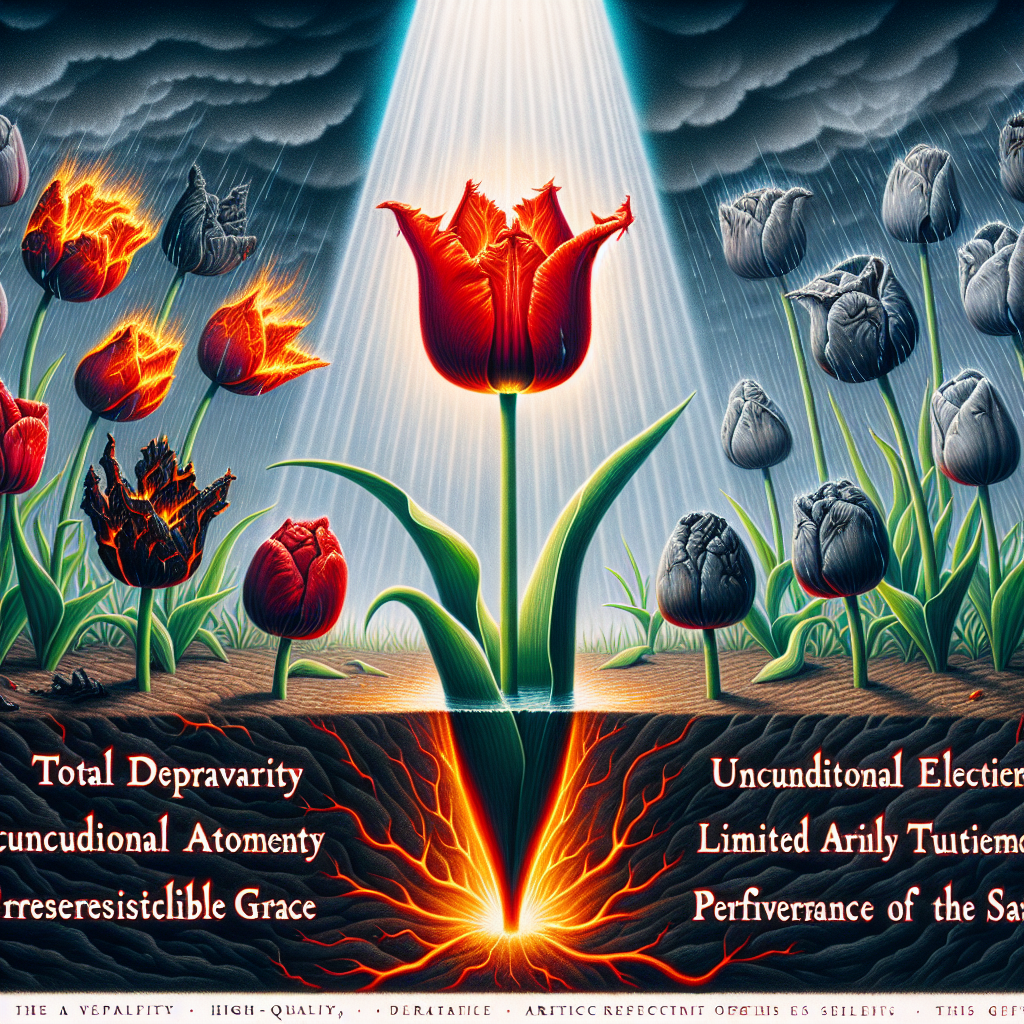
TULIP is a mnemonic — not something Calvin himself wrote, but a summary that emerged from the Synod of Dort (1618-1619), where Reformed theologians responded point-by-point to a movement called Arminianism that had raised five objections to Reformed soteriology. The five letters are the five Reformed answers:
- T — Total Depravity
- U — Unconditional Election
- L — Limited Atonement (better called Definite Redemption)
- I — Irresistible Grace
- P — Perseverance of the Saints
Here's the thing people miss: these aren't five unrelated doctrines someone bundled together for a catchy acronym. They're one argument, told in five movements, about how a person actually gets saved from beginning to end. Which is to say — you understand TULIP a lot better once you stop reading the letters as a checklist and start reading them as a sequence.
T — Total Depravity: The Diagnosis
Everything starts with an honest diagnosis. Total depravity doesn't mean people are as bad as they could possibly be — your neighbor who mows your lawn when you're sick isn't secretly a monster. It means sin has affected every part of a person — mind, will, affections — so thoroughly that no one, left to themselves, will choose God on their own initiative. Romans 3:11 puts it starkly: "no one seeks for God." Not "few." No one.
U — Unconditional Election: The Reason Anyone Is Saved At All
If no one seeks God on their own, then anyone who ends up saved got there by something other than their own initiative. That something is unconditional election — God's choice, before creation, to save particular people, not on the basis of anything he foresaw in them (not even foreseen faith), but according to his own purpose and grace (Ephesians 1:4-5). I know that sounds like a cop-out — "just because God said so" — but stay with it: the alternative is that God's choice depended on something in you being marginally better than someone else's, which somehow feels worse the longer you sit with it.
L — Definite Redemption: The Guarantee
If God chose particular people beforehand, it follows that Christ's death was designed to actually secure salvation for those particular people — not merely make salvation a hypothetical option for everyone in general. That's definite redemption, and it's the letter that scares people most because of its unfortunate traditional name, "limited atonement." Nothing about the doctrine limits the cross's worth. It just insists the cross actually accomplishes what it sets out to do, for the people it was for.
I — Irresistible Grace: The Application
Election and redemption don't save anyone automatically, from a distance. At some point in a person's life, the Holy Spirit works effectually — not by force, but by genuinely changing what a person wants, so that they come to Christ willingly and gladly. That's irresistible grace, and — this is the part that took me years to see — "irresistible" doesn't mean "coerced." It means that when God decides to make someone able to see, they see. Nobody drags a person kicking and screaming into loving God; God changes what the heart finds beautiful.
P — Perseverance of the Saints: The Finish
And finally: if God chose you, Christ died to secure you, and the Spirit effectually called you, then your salvation isn't hanging by the thread of your own future consistency. Perseverance of the saints — sometimes called "once saved, always saved," though that phrase flattens a richer idea — teaches that those God truly saves, he keeps, to the end (Philippians 1:6, John 10:28-29). Not because believers never stumble, but because their standing was never resting on their grip in the first place. It was resting on his.
Why the Order Matters
Read straight through, TULIP isn't five scary doctrines. It's one sentence: because people can't save themselves (T), God chose to save particular people anyway (U), Christ's death actually secured their salvation (L), the Spirit effectually brings them to faith (I), and God keeps what he starts (P). Pull out any single letter and read it alone, and it can sound harsh. Read all five together, and what you're actually looking at is a salvation that doesn't depend, at any single point, on you holding up your end.
Key Takeaways
- TULIP summarizes five Reformed responses to Arminian theology, formalized at the Synod of Dort.
- The five letters aren't independent doctrines — they're one continuous account of salvation from human inability through to final perseverance.
- "Limited atonement" is widely considered the worst-named letter; "definite redemption" better captures what the doctrine actually claims.
- Each letter is worth a deep dive on its own — start with whichever one currently makes you the most nervous.
Which letter of TULIP do you find hardest to accept — and have you ever actually read the case for it, or just the caricature?
Further Reading
- R.C. Sproul, Chosen by God
- David Steele, Curtis Thomas, & Lance Quinn, The Five Points of Calvinism
- The Canons of Dort (the original historical document TULIP summarizes)
Frequently Asked Questions
What does TULIP stand for?
TULIP stands for Total Depravity, Unconditional Election, Limited Atonement (or Definite Redemption), Irresistible Grace, and Perseverance of the Saints — the five points of Reformed theology formalized at the Synod of Dort.
Did John Calvin create the TULIP acronym?
No. The five points emerged from the Synod of Dort (1618-1619) in response to Arminian objections; the TULIP acronym itself came later as a teaching tool.
Is TULIP the same as Calvinism?
TULIP represents the five points where Reformed theology historically responded to Arminianism, but Calvinism as a broader theological system includes much more, including covenant theology and the doctrines of Scripture and worship.
Which TULIP point is most controversial?
Limited atonement (definite redemption) is typically considered the most controversial and misunderstood of the five points, often due to its name rather than its actual content.
About the Author
Enjoyed this? Support the writers keeping CrazyChurch.net running and spreading the word.
Buy Us a Coffee